
STORYTELLING / SALES
Your Best Sales Story
Might Be Losing You Deals
Same seller, same buyer, two stories. One opened the door. The other closed it.

Priya, an operations director at a regional logistics company, gave Mike fifteen minutes on a video call. Her camera was on, but her eyes were on a spreadsheet on her second monitor. Before Mike reached his second sentence, she cut in: "So, Mike. What is this about?"
Mike did something smart. He didn't pitch. He asked for twenty seconds of context and told a tiny story.
Early in his career, he'd stood in a depot at the start of a shift while a supervisor pointed at a whiteboard covered in red magnets. "Every magnet is a late truck," the supervisor said, "and every late truck is three angry phone calls." Then Mike handed the conversation back with one question: when a shipment starts to slip, where does it usually get stuck? The pick, the scan, or the handoff to transport?
The typing stopped. Priya looked into the camera for the first time. "It's the handoff to transport," she said. "It's always the handoff."
She had just told a stranger her real problem. And Mike, hearing that it rhymed with his favorite case study, did what most of us have been trained to do. He told it.
It was a good story: a distribution firm in the same squeeze, forty minutes lost every morning, overtime nineteen percent over plan, missed delivery targets nearly doubling, and the fix his company had built. It was true, relevant on its face, and polished the way a story gets polished when you've told it forty times.
Somewhere around the overtime number, Priya's eyes drifted back to the spreadsheet. A message pinged, and this time she read it. "Mm-hmm," she said, and glanced at the clock in the corner of her screen.
"We're not a distribution company," she said, not unkindly. "That doesn't really fit our situation. Look, I have a hard stop. Send me something."
The call ended four minutes early. On a fifteen-minute call, four minutes handed back isn't a courtesy. It's a verdict.
Mike and Priya come from my book. They're composites, built from patterns that kept recurring in my research with B2B sellers, but the moment is real in the way that matters: it keeps happening. You've probably been Mike at least once.
The difference was never the story
Within a few minutes, Mike told the same buyer two stories. The first took about twenty-five seconds and opened a door.
The second was arguably the stronger story: more detail, more numbers, better rehearsed. It closed the door.
The first one arrived with permission and ended with a question about her world. The second began the moment she stopped talking and ended when she checked the clock.
"Best" isn't a property of a story. It's a fit between a story and a moment.
In my research, I interviewed and observed B2B sellers in complex deals, watching how they used stories in live selling situations. Mike's misfire kept turning up, in different rooms, on different faces. The stories that backfired often weren't badly told. They were the right story at the wrong moment, or with the wrong ending.
Applause or a bridge?
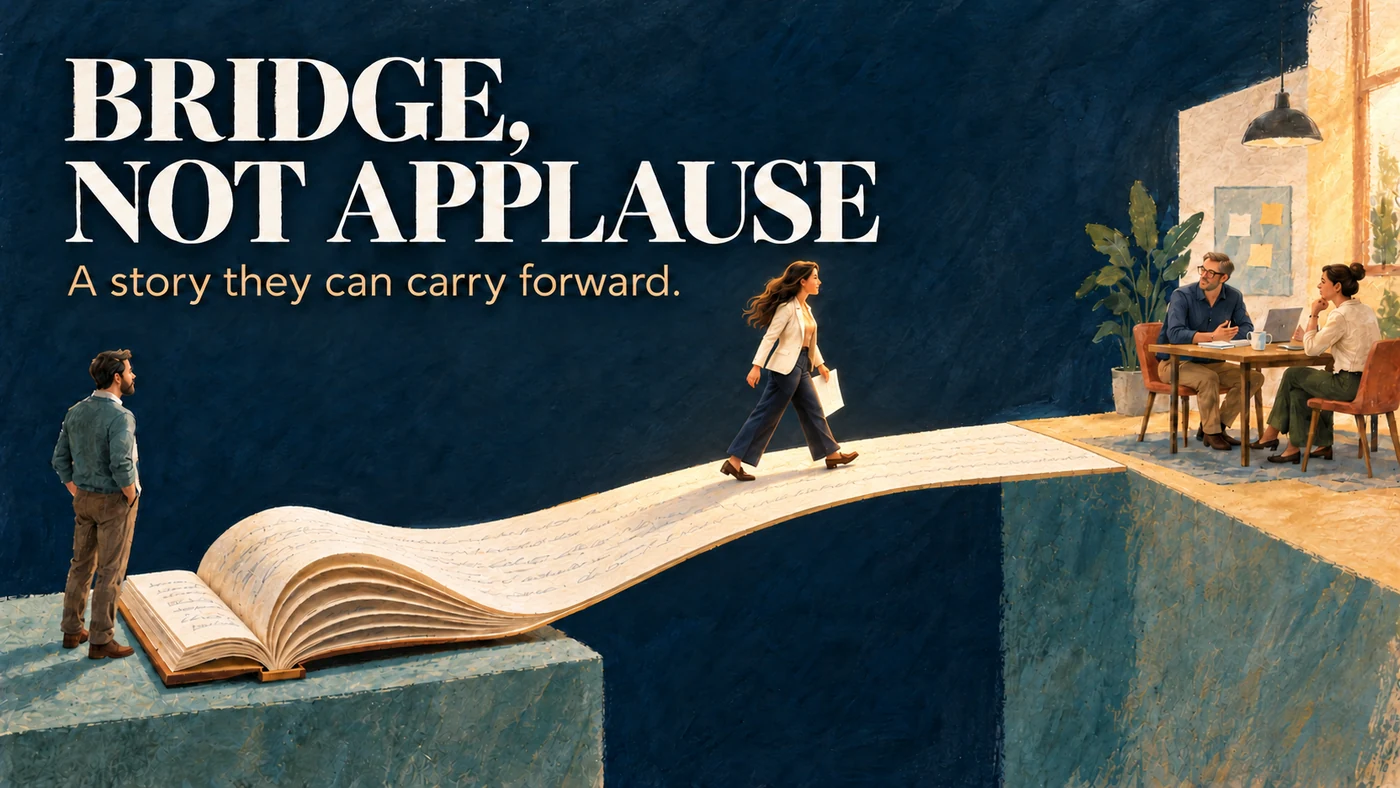
I call it the difference between applause and a bridge.
A story told for applause ends with the buyer impressed. It feels like it landed. But applause is what a buyer gives you while reaching for the exit, and nothing has moved.
A bridge starts on the buyer's ground, with a scene they recognize, and it ends there too, leaving them somewhere new: seeing their situation more clearly, with words they can repeat in their next meeting.
A stage points the audience at the performer. A bridge gets someone to new ground, then leaves them free to walk it.
In complex B2B, the person who hears your story is rarely the one who signs. Your champion has to carry your idea into rooms you'll never enter: the CFO's office, the buying committee, Monday's leadership meeting. Applause doesn't survive that trip. A story the buyer can retell in their own words does.
When that doesn't happen, deals rarely die with a no. They dissolve. Nobody is against it, nobody is for it enough, and the deal drifts into the most expensive outcome in B2B: no decision.
How to tell which one you just got
In the moment, applause can pass for a bridge. It's warm and polite, and it feels like progress. So stop guessing what the buyer is thinking and watch what they do. These are the three signals I teach sellers to look for:
- The pause. They stop doing something else. The typing stops, and the eyes leave the second screen.
- The specific answer. Not "yeah, handoffs are tough," but the mechanics, in their own words: what breaks, when, and who carries it. Buyers answer performances with politeness. They answer relevance with specifics.
- The question back. The moment the buyer asks you something, the conversation starts to belong to both of you.
Replay Mike's call. The red magnets story earned the first two signals almost at once. The distribution story earned applause signals instead: eyes back on the spreadsheet, a glance at the clock, a polite "mm-hmm."
Mike took that "mm-hmm" as encouragement. It's really the sound a door makes as it starts easing shut.
Treat the signals as clues, not a scorecard, because people and cultures differ.
The test that keeps your stories honest
One more test matters most to me. I call it the Agency Test.
After your story, is the buyer clearer and freer than before? Are they better able to check what you said, correct you, choose, pause, or even say no? Then you built a bridge. If they're dazzled, cornered, or just two minutes older, it was a performance.
Because stories move people, they can be misused. A useful story increases the buyer's agency. A manipulative one reduces it.
It also means a pause is a legitimate outcome. So is "this isn't a fit." If your story helps a buyer see in week two that they don't need you, it has done you both a favor. We don't build bridges to drag people across them.
Four ways to turn your next story into a bridge
You don't need to throw out your best stories. You need to change when you tell them, how long they run, and where they end.
- Decide first: answer, ask, tell, or skip. A direct question about price, security or an outage gets a straight answer first. If the buyer has just opened up about their real problem, ask a follow-up, or skip the story and let them keep talking. Tell only when the moment calls for it. Mike told when the moment was begging him to ask.
- Ask before you tell, and honor the clock. Try "Before I answer that, can I take twenty seconds for some context?" Then take twenty, not ninety. Permission turns a story from an interruption into something the buyer chose to hear.
- Start short. Twenty seconds is usually enough: a person, a moment the buyer will recognize, what it cost, and what changed. If you use a number, use one, and say where it came from and where it stops. Length is bought with the buyer's questions, not your enthusiasm.
- End on their ground. Close with one question about their world, not a flourish about yours, like Mike's: the pick, the scan, or the handoff? Then stop talking and let the silence work.
Try it this week
Take the story you always reach for, like your favorite case study. Cut it to twenty seconds, and replace the ending with one question about the buyer's world.
Then use it in one real conversation this week. Don't listen for applause. Watch for the three signals: the pause, the specific answer, the question back. If even one shows up, you've felt the difference between applause and a bridge.
About the book
The idea that a sales story should end with a bridge, not applause, is the heart of my upcoming book, Bridge, Not Applause: How to Use the Right Story at the Right Moment in Complex B2B Sales.
In her foreword, Lisa Earle McLeod, author of Selling with Noble Purpose, calls it a book about story judgment, not story craft. With AI now able to write a polished story in seconds, she argues, that judgment "is about to become the whole job."
The book follows one complex deal from the first cold call to the renewal almost a year later. You're in the room for discovery, the boardroom, procurement, a contract stuck in legal, cold feet at the signature, and a live failure after go-live. You see the calls Mike got right alongside the ones he'd rather forget, and every scene is built from recurring patterns in my interviews and field observation.
It teaches one simple framework, the MOMENT Bridge, and puts it to work in dozens of specific selling moments, from "We have preferred suppliers. Send a PDF." to "Thirty percent cheaper. Convince me." It finishes with a field guide built for a working Monday.
Colleen Francis, founder of Engage Selling Solutions, put it this way: "Finally, a sales book that doesn't stop with the signed contract."
I'll be sharing more of the book's ideas here, starting with the MOMENT Bridge itself. If you've ever told a great story and watched a buyer check the clock, follow along.